Wednesday, January 17, 2024

AD&D 2e Play Report: Session 5

We played the fifth session of our ongoing AD&D 2e game last night. The summary of our last session is here. To recap briefly: The party had mostly cleared out the Warlord's Tower and freed the stonemasons they'd been sent to find. They searched the rest of the tower, found the remaining cultists and their leader, and retreated to rest. The cultists attacked them in the night and the party defeated them. The party spent a day resting to regain hit points, fought some giant rats of no consequence, and looted the tower, finding a magic greatsword in the process.

We began the session with the party's journey back to Spiritbrook. The journey would take roughly three and half days, and the party would follow the river so as to avoid getting lost. They would descend forested mountains and hills and cross some farmland before arriving back in town.

More on Encounter Checks

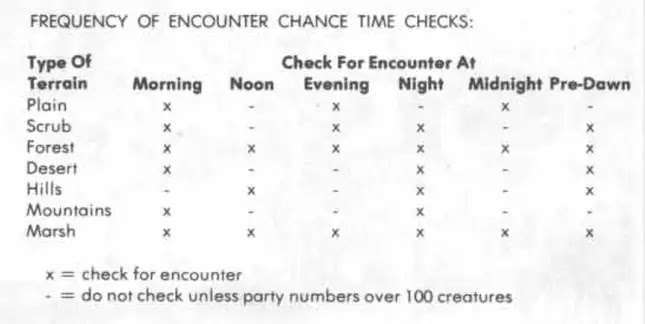
I've written about how I check for random encounters in the past, but wanted to expand on it here. On page 138 of the AD&D 2e DMG, there's a table like this:

I think this one is actually from the 1e DMG, but I can't find an image of the 2e one online (and don't have a PDF of the 2e DMG). This table largely the same as the 2e version, except that the 2e one includes jungle, ocean, and arctic, as well as the encounter chance for each type of terrain (expressed as an X-in-10 chance).

I like using this table for two reasons:

  1. The day is broken up into six four-hour windows, which is how long my wilderness travel turns are. Usually, two turns are spent traveling, two are spent making camp and foraging, and two are spent resting/keeping watch.
  2. The table doesn't require a check every single turn (except in forests and marshes), which speeds things up a bit. I'm not going to claim it's "realistic", but there's some element of realism to it - the party won't encounter monsters in the desert during the hottest and coldest periods of the day, for example.
When terrain types mix (i.e. forested mountains and hills), I use the least advantageous of the terrain types, so although no encounter checks are called for in the mountains during the noon, evening, midnight, and pre-dawn turns, I still check for forest encounters if the party is traveling through forested mountains. 

When I roll an encounter, I use the result on the d10 to determine if I should use the forest (2-in-10 chance) or mountain (3-in-10 chance) encounter tables. If the result is 3, I know to use the mountain encounter table. On a result of 1 or 2, I roll d2 to determine which table to consult.

The Hanged Men

I rolled an encounter on the party's very first travel turn. I had decided ahead of time what the first encounter of the session would be. The party was just a few hours out from the tower when they found the mercenaries whose lives they had spared, riddled with arrows and strung up in the trees.


The party had no great fondness for the mercenaries, and concluded (correctly) that they had run afoul of the forest people which the party had encountered on their original ascent. The players remembered that the forest people had mistaken them for mercenaries and nearly attacked them because of it. I felt like I had done a great job of illustrating the enmity between the two groups and felt validated that my players had been paying attention. Not wanting to meet a similar fate, the party proceeded cautiously.

They didn't go far before the forest people emerged to confront them. There were ten warriors, led by a 2nd-level fighter and a 4th-level druid (one bit of information which AD&D's Monstrous Manuals included and which has been lost to time is detailed information about what types of leaders are found among large groups of monsters - I would consider this mandatory were I ever to make my own monster manual).

No image or flavor text has ever made me want to play a druid as much as this guy.

The forest people were, again, unfriendly (reaction roll: 4). They had surrounded the party, and were ready to attack. Haymond Baler, cluelessly amicable, exclaimed "Oh hey guys!" The druid stepped forward, eyeing the greatsword carried by Bernhardt Dalton. He introduced himself as Valdemar, of the Burned Earth Tribe, and suggested that the party relinquish the sword to him.

A tense negotiation followed, with the party asking questions about the sword's nature and history. The druid told them that the sword, Infamy, had been wielded by an evil tyrant in the past to slaughter their people (true), that they had been seeking it so as to prevent it from falling into the wrong hands (true), and that they planned to destroy it (false).

Rozidien Stoneskull used his ability to detect evil, detecting evil from the sword and a more subtle evil intent in the forest people (the kind of evil that resides in the hearts of most mortals). Since the druid didn't register as evil (druids are by nature True Neutral in AD&D), Rozidien was okay with handing over the sword.

There was some protest from Terris, who used a greatsword as his preferred weapon, and had no qualms about wielding an evil sword - perhaps he had already begun to fall under its sway? The party put their hireling in place, asked the forest people for information about the surrounding area (they were reminded to avoid strange lights in the woods at night, which could be signs of an evil spirit nearby), and went on their way.

Greetings, Fellow Adventurers!


The rest of the day passed without incident, and the party made camp. I rolled another random encounter on the first watch of the evening. At first I rolled something very unexpected - a sphinx. On the sphinx subtable, I rolled something very bad - a hieracosphinx, the only Chaotic Evil sphinx, and a 7th-level monster. TPK, here we come! Looking at the monster's entry in the MM (page 324), I found that it dwells only in deserts. Crisis averted.

Rerolling, I got men. On the men subtable, I rolled characters, meaning an adventuring party. The section on humans in the MM (pages 196-7) divides adventurers into low level (1-3), mid level (4-7), high level (7-12), and very high level (9-20). Rolling d100, I got a result of 98 - very high level adventurers!

Quickly referencing Appendix III: NPCs (which should be titled "NPC Parties", page 379), I quickly generated a party of four very high level adventurers with four henchmen of 3rd- to 11th-level. They were mostly elves and halflings, with four fighters, three clerics, and led by a Chaotic Good half-elf ranger. They were friendly (reaction roll: 9).

In the future, I'll probably take some time to generate a handful of adventuring parties ahead of time (one low level, one mid level, one high level, and this one, albeit more fleshed-out) for this sort of situation. Generating a party on the fly is easy enough if I just want to determine general power level and race and class composition, but takes considerably longer if I want to factor in specifics like magic items, spells, and the like.

In my last campaign, my players had a hated rival adventuring party, the Gladiators of Patience. The Gladiators betrayed and nearly TPK'd the party, and from then on the party would stop at nothing to hunt them down and kill them. For a laugh, I decided that the first party of adventurers the group encountered in this campaign would also be the Gladiators of Patience. Little did I know they would be this world's Avengers!

I decided that the Gladiators had come from Spiritbrook after hearing about some missing stonemasons and a party of inexperienced adventurers who had gone looking for them about a week ago. They were delighted to see that the party was alright and that they had rescued the masons. 

"Only...you didn't happen to find an evil sword, did you? Oh, alright then. At least you didn't run into that evil Burned Earth Tribe and give them the sword. You did? Ah well, you'll learn. Yeah, they're going to reunite the sword with the evil spirit they worship, which unbeknownst to them is actually the spirit of the evil warlord who once ruled here. If the spirit is reunited with the sword, the warlord will return to the world, and he'll bring back the Bone Lord. That's fine, we've fought the Bone Lord before. Damn Bone Lord cult. We should have gone to his divine realm and finished him when we had the chance. Don't worry about it. There's a harpy nesting at the tower? We'll take care of that too. Thanks for the tip!"

This was a delight to run. The Gladiators recognized Haymond as a farmer-turned-adventurer and told him what a great career path it was - half of them were former farmers themselves! They warned the party that the farmers near Spiritbrook must be feeding the giant toad in the river, because it followed them for some time before they gave it some food to leave them alone. They recommended always carrying a dagger in case they get swallowed by a monster, since only daggers can be used effectively when swallowed. The Gladiators have a guildhall in the city, called the Fighting Pit, which they invited the party to come visit some time. The Gladiators throw legendary parties.

Terris, hearing that the Gladiators intended to go after the sword, wanted to go with them. The party reminded him that he was still on their payroll. The Gladiators said they didn't mind if he tagged along, but didn't want to get in the middle of hireling business. 

Don't Feed the Wildlife

The following day's travel passed without incident, with Terris grumbling about how he should have gone with the Gladiators. The party heard a pack of wolves howling somewhere in the distance, but they were indifferent (reaction roll: 6) and left the party alone. The party had a similar encounter with a pack of wild dogs on their way up to the tower in our first session, so they dubbed the area "the Wolfhowl Hills".

While setting camp, the party spied a mated pair of adult owlbears with two cubs, foraging for food. The owlbears smelled the party, and started heading in their direction - the owlbears were friendly (reaction roll: 9), so similar to the brown bear the party encountered on their ascent, I decided that they were looking for food. 


The party quickly broke down their camp and made an effort to evade the owlbears, leaving some food to distract them. They made camp again somewhere far away, but still in earshot of the river so that they could find their way back.

My girlfriend gets so mad whenever I relate these encounters to her. Don't the players realize that they're teaching these dangerous animals to associate people with food?

Gumbo's Kobolds


The party was on the edge of the hills, entering into flatland forest, when they were attacked. I rolled an encounter, got 18 kobolds, and determined that they were hostile, attacking on sight (reaction roll: 3). The kobolds were 120 feet away, so at medium range with their javelins. Bernhardt and the hirelings were surprised as a cry of "Bree-yark!" erupted from the forest, and missiles rained down on them from bushes lining the rocky outcroppings above the path. The stonemasons, though armed, were noncombatants by nature, and failed their morale check. They took cover and cowered as the fight began.

I decided that three kobolds were attacking each party member. Rozidien charged towards the nearest group. Haymond closed distance while firing with his sling. Karven Stone started Dark Souls rolling towards the nearest source of cover. 

We argued for about 20 minutes over whether or not Karven's tumbling proficiency (which grants +4 to his AC) allows him to move at full speed, which I ruled it doesn't. The description of the proficiency (PHB, page 87), isn't clear on this point, the way many mechanics in AD&D lack clarity, so I explained that the group is going to have to get used to my making rulings like this. The description specifies that the character must forego attacking, and attacking normally only allows the character to move at half speed, so I ruled that tumbling is done at half speed as well, or else the character would simply tumble everywhere if they weren't otherwise able to attack. This is certainly 20 minutes of game time I wish I could get back.

Yinvalur Sparkguard went down during the first round, while still surprised, and Bernhardt moved in to cure him with cure light wounds. Bernhardt was struck by a javelin before the casting was finished, and so the spell fizzled. This came as a shock to Bernhardt's player, who with each session is learning more and more about the restrictions placed on spellcasters in AD&D, such as needing to remain completely still during any round that a spell is cast.

The fight was a bit of mess, as we use theater of the mind combat for random encounters, rather than a grid. I had to keep track of all 18 kobolds, approximately where everyone was, who had cover or concealment, the degree of cover or concealment, and attack roll modifiers due to cover, concealment, and range. I'm not afraid to admit that I often forgot about attack roll penalties, and that at times made the fight more difficult for the players. All of this definitely made the fight more difficult to run, but I also found it more engaging and interesting, so I'm hoping I just get used to tracking the modifiers with more experience.

The kobolds were critting like crazy - almost every player took at least one or two critical hits. It was brutal. In the end, Haymond, Karven, and Rozidien were all unconscious, along with Yinvalur. Terris's morale broke and he ran off into the forest, yelling about how he should have joined the Gladiators when he had the chance. Bernhardt did his best to tend to the wounded, but eventually he was alone against the eight surviving kobolds, who time after time succeeded on their increasingly difficult morale checks.

As a last ditch effort, Bernhardt, in cover, beseeched the stonemasons to take up arms against the kobolds. Bernhardt has a -2 to reaction rolls due to his low Charisma, but this was cancelled out by the masons' +2 due to their friendly disposition towards the party. I made a reaction roll, and for once luck was on the party's side - I rolled a 9. The masons, inspired by Bernhardt's words and the dire straits their saviors were in, rattled their sabers and broke cover to charge the remaining kobolds.

I don't have a great procedure for mass combat, so I made one up on the fly. The masons and kobolds were each approximately level 1 creatures, so I rolled one die for each fighter on each side. The masons have a d6 hit die, and the kobolds have d4, so I rolled 8d6 (for eight masons) against 8d4 (for eight kobolds) and compared the results. A success of one die versus another meant that individual was killed, and a tie indicated an ongoing struggle. Bernhardt brought up the rear, tending the wounds of any injured masons.

The first round, five kobolds and one mason were killed. The following round, another mason and the remaining kobolds were killed. Another TPK averted, and it didn't require DM fiat or a deus ex machina, just quick thinking from the players and a lucky roll! 

Despite the difficulties, this might be my favorite combat encounter I've run so far. The kobolds had 18 hit dice worth of combatants on their side, whereas the party had just 10 (four 2nd-level characters plus two 1 HD hirelings). They were at a disadvantage due to the terrain, and had some terrible rolls working against them, but they persevered. 

Bernhardt used a few spell slots to cast cure light wounds and revive those who remained unconscious, and that's where we wrapped. The party earned experience for the encounters with the forest people and with the kobolds, and both Bernhardt and Karven leveled up again - they're now 3rd-level. They both gain some hit points, Bernhardt gains a nonweapon proficiency and access to 2nd-level priest spells, and Karven's THAC0 improves to 19.

With luck, next session the party will finally arrive back in town. They'll get a nice chunk of experience and gold for completing their quest. There, they can decide if they want to take on the other 1st-level quest they've heard about, or if they'd like to spend downtime gathering information about 2nd- or even 3rd-level adventures to try their hands at.

Friday, January 12, 2024

On Language

The topic of languages in RPGs is a contentious issue. In D&D, language acquisition is unrealistic. It's a binary on-off switch - when a player character decides to learn a language, they suddenly know it in its totality, and can engage in conversations of varying complexity with all speakers of the language, regardless of things like dialect. 

Real-world "intelligence" (whatever that means - my education in psychology has taught me that it's hotly debated and that a nuanced understanding of "multiple intelligences" is more accurate) has little to do with language acquisition - it's much more important to be immersed in a language from an early age, suggesting that a PC's background is more useful as a metric for what languages they should know. So why do older editions of D&D and OSR games use Intelligence to determine language acquisition?

Others argue that because it's so difficult for humans in the real world to learn languages from cultures other than their own, it makes little sense in a fantasy game for intelligent creatures of one species to sufficiently learn the language and understand the worldview of an entire other species.

And that's not even touching on what alignment languages are supposed to represent.

It's not only appeals to realism which are used to critique language proficiency in D&D. Language acquisition happens most frequently during character creation, when a player's knowledge of the setting, the challenges they may face, and the languages they might encounter is often incomplete. 

The result is that if the players choose the "wrong" languages, they end up missing out on valuable information, and consequently have fewer choices - they are either less well-equipped to make informed decisions, or they are locked out of certain approaches to situations. If the party encounters unfriendly or hostile intelligent creatures and they do not share a language, negotiation is more or less not an option, which means combat often becomes the only way forward.

I'm not particularly concerned with realistically representing language acquisition in my games. In D&D, language is often just another challenge to overcome, whether by clever roleplaying or with hard-coded skills. Ability scores are one among many abstractions in D&D which are necessary to keep the game relatively simple and gameable. I'm not trying to introduce six new ability scores to represent the different types of intelligence, for example. 

I view Intelligence in D&D not as a character's inherent smartness, but more as the level of education and learnedness that a new character enters the game with. When a wizard in D&D 5e, for example, increases their Intelligence as they level up, it doesn't represent a magical increase in their inherent ability to learn - it represents a deepening knowledge of the world gained through adventuring and study. 

It makes enough sense to me that a wizard would begin the game with a higher Intelligence due to their study under a mentor or at an academy, and thus would have a greater capacity for language acquisition and use, even if attributing such a thing to a single measure of "intelligence" in the real world might be overly simple and potentially problematic. 

I also don't think it makes the game more interesting to forego the acquisition of exotic languages entirely just because it doesn't necessarily make sense for a human to be able to fully comprehend the nuances of not just Dwarvish vocabulary and grammar, but also the Dwarvish worldview.

I do agree with two of the above points: that language acquisition is too binary, and doesn't account for the complexity of interpretation, and that the nature and timing of language acquisition in the game often leads to uninformed decisions which unfortunately lock players out of certain choices in play.

Language is a Proficiency

Beginning with AD&D 2e, if the optional proficiency system is used, language has been one of many possible proficiencies available to player characters in D&D. 

It continues to be a proficiency in 5e, but for some reason isn't used as such. If a character is proficient in a language, they simply know it - no check is required to speak, read, or write in that language. The only other proficiency which is treated this way is armor - even weapons technically require an ability check (an attack roll) every time a character attempts to use them. This is a major missed opportunity for language. If language is instead treated like any other proficiency, a world of possibilities emerges.

Language is a Skill

My house rule for using languages in 5e works like this: Any languages which a character acquires via their race (Common and Dwarvish, for example, if the character is a dwarf) is a native language. The character grew up speaking it and can speak, read, and write in that language without difficulty. Any other language that character knows (such as those acquired from the character's background, the occasional class feature, or downtime spent studying) is a learned language.

Non-native languages always require an Intelligence (Language) check when the character attempts to speak, read, or write in that language. If the character has proficiency in the language, they can apply their proficiency bonus to the ability check. A success indicates that the character has successfully communicated their intent or understood the intent of another. A failure indicates a misunderstanding, mistranslation, or faux pas. 

The difficulty class of the Intelligence (Language) check is determined based on a variety of factors, including the complexity of the ideas being communicated, vocabulary used, expected etiquette, the speed with which another creature is speaking to the interpreter, legibility of the writing, and the like.

At the DM's option, a failed Intelligence (Language) check to comprehend a speaker or piece of writing may still allow the character to glean some information in the form of common or key words:

Degree of Failure    Number of Words
1-4                            1d12
5-9                            1d10
10-14                        1d8
15-19                        1d6
20+                           1d4

Alternatively, a simpler rule would be to say that a failure of 5 or less indicates that 1-3 key words are understood, and a failure of more than 5 indicates that a (potentially) disastrous misinterpretation has occurred.

This not only allows for a less binary system of language acquisition, but also for the possibility that characters who don't necessarily have proficiency with a language can still attempt to understand it. In that case, an Intelligence check without proficiency is made. A success means that the character conveys or understands more or less the gist of what's intended. No longer are the players locked out of negotiating with the goblins just because nobody picked Goblin as a language in character creation!

This may seem unrealistic to some, but adventurers are worldly individuals who interact with all manner of creatures. It makes plenty of sense to me that they may pick up a few common words here or there, or that the wizard with their nose in a book at every opportunity is somewhat capable of navigating simple and intermediate conversations in a foreign tongue. Many adventurers would know that "bree-yark" is Goblin for "We surrender"...it is, isn't it?

Treating language as a skill proficiency has a few added effects. Any mechanic which interacts with ability checks can be applied to language ability checks. 

Skill Mechanics

If language is treated as a skill, characters who gain the expertise feature (such as bards and rogues, and those characters which take certain feats) can take expertise in a language if they wish to get a better grasp than most. 

Bards at 2nd-level gain the Jack of All Trades feature (PHB, page 51), which allows them to apply half their proficiency bonus to skills with which they're not already proficient. Now that applies to languages, too. The bard is the worldliest and wordiest of adventurers, after all, so it stands to reason that they would have a better than average grasp of even those languages they haven't devoted time or resources to learning.

Rogues also benefit, as at 11th-level they gain the Reliable Talent feature (PHB, page 94), which prevents them from ever rolling under 10 on an ability check with which they have proficiency. Now the rogue has more or less mastered even the slangiest thieves' cant, as well as any other languages they've picked up on their adventures. This sort of harkens back to the thief's ability in past editions to read any language, though I'm tempted to give them a version of Jack of All Trades which applies only to language ability checks to represent that more accurately.

One of my favorite 5e mechanics is found in Xanathar's Guide to Everything, Chapter 2: Dungeon Master's Tools, under Tool Proficiencies (page 78). The rule pertains to the use of tool proficiencies in combination with skill proficiencies: "If the use of a tool and the use of a skill both apply to a check, and a character is proficient with the tool and the skill, consider allowing the character to make the check with advantage."

When I read this, I decided to completely ignore the fact that it specifically refers to using tools, and started using this mechanic any time my players did anything that could conceivably fall under more than one of their proficiencies. Trying to use historical precedent to convince an NPC to do something? That's a Persuasion check, and if the character has proficiency with History, it's made with advantage. Trying to trick the cultists into believing that the character is a fanatical follower of the Bone Lord? That's a Deception check, and if the character has proficiency with Religion, it's made with advantage.

This can work with language ability checks, too. A character may be able to kind of sort of get by speaking and interpreting another languages sometimes, but they're particularly well-versed in a certain field of study and have learned several words which are important when discussing it, or reading or writing about it. 

If the character is building a stronghold and wants to communicate construction specifications to the dwarf stonemasons, the character's proficiency with mason's tools applies, and they have advantage on their check to communicate their intent. A character with proficiency in Religion is better able to communicate and interpret religious ideas to and from goblins. A character with proficiency in Nature is better able to decipher an Elvish bestiary with information on the mating habits of owlbears.

Lost in Translation

Another benefit of using ability checks for language is that it can complicate negotiations. When the character succeeds in an attempt to communicate, and is simultaneously attempting to deceive, intimidate, or persuade the creature to which they're speaking, the result of their language ability check can also be used a cap for the following Deception, Intimidation, or Persuasion check (i.e. if the result of the language check is 15, the following Charisma check cannot be higher than a 15). The bard may be great at working a crowd, but their ability to work a crowd of orcs is much less potent than it would be with a crowd of humans.

For best results, this mechanic should be combined with a robust system for social interaction.

Related Languages

Languages in the real world often share connections. An English speaker can sometimes follow the meaning of a Spanish speaker because some of the words are alike. It stands to reason that fantasy languages would also share commonalities. To determine which languages in 5e are related, I refer to their scripts:

If two languages share a script, then they're related. If a character attempts to converse in or comprehend a language with which they are not proficient, they have advantage on the ability check if they're proficient in a related language.

Standard and Exotic Languages

D&D 5e makes a useful distinction between "standard" and "exotic" languages (PHB, page 123)...which then isn't actually used at all, except to say "With your DM's permission, you can instead choose a language from the Exotic Languages table". I don't think I've ever had a player ask my permission to learn any language during character creation.

Standard languages are those spoken by the typical player character races - Dwarvish, Elvish, Halfling, and the like. Exotic languages are typically those spoken by monsters - Celestial, Draconic, Infernal, etc. I've written before about how the DM can, prior to character creation, change up which languages are standard or exotic based on the setting.

I don't love that it's equally easy to learn both standard and exotic languages - after all, what makes exotic languages exotic, other than this vague notion of "Hey, maybe ask your DM first, if you want"?. 

I house rule that if a feature allows a character to learn two or more languages (such as with certain backgrounds), the character can learn one exotic language in lieu of two standard languages. A character with the sage background can learn Dwarvish and Elvish, or Infernal, but not Dwarvish and Infernal.

To represent the difficulty of fully grasping an exotic language, I recommend increasing the DC of Intelligence (Language) checks made to speak or comprehend exotic languages by at least 5 across the board. (I actually roll to determine the DC of most ability checks during prep, so I usually roll twice and take the higher result when it comes to exotic languages.) 

Learning Languages

I use XGE's rules for the training downtime activity (page 134) to handle language acquisition beyond those languages learned by other means. The downtime activity normally takes ten weeks and costs 25 gold per week. I house rule that learning an exotic language instead takes twice as long and costs 50 gold per week.

This is one case where I would apply a limit to the maximum knowable languages based on Intelligence. Otherwise, with enough downtime and cash, player characters can learn every language (which is maybe fine, but I still want there to be some tradeoff and element of strategy when deciding which languages to learn - if the character only gets three, then the player better choose them carefully, ideally after spending some time in the world and determining which languages are most useful).

If the DM wants to stick with mechanics which exist in 5e, the number of languages can be limited by the character's Intelligence modifier, meaning that a character of the highest degree of nonmagically-augmented Intelligence can learn five languages, which seems fairly reasonable. Through magical augmentation and ability score increases beyond 20th level (DMG, page 230), a character's Intelligence modifier can go all the way up to +10.

Quantum Language

As evidenced by the many hyperlinks in this article, there's a wide variety of discussion on this topic. I wasn't sure how else to work it into this post - and my "ability check without proficiency" approach pretty much covers the possibility for any character to know (enough of) any language at any given time - but one might also consider playing around with quantum languages as another way of doing things.

Conclusion

None of this is to say that this is a 100% fix for language in D&D 5e, but I think it's a big improvement. Obviously, language in 5e is intended to be a binary ability - the character either knows the language or they don't - but this to me is a much more interesting way of doing it. 

This approach mitigates the binary nature of language acquisition, which also makes the player's specific choice of known languages at the start of the game less crucial, and allows for a wider array of character choices in encounters with NPCs, even if the characters and NPCs don't share a language.

Wednesday, January 10, 2024

AD&D 2e Play Report: Session 4

In our last session, the player characters continued their exploration of the Warlord's Tower, battled some cultists, succumbed to magical fear, nearly died, fought a magical hand, and liberated the captive stonemason's they'd been hired to find.

The hirelings, Terris and Yinvalur Sparkguard, were taking the unconscious cleric and thief, Bernhardt Dalton and Karven Stone, to the mercenaries' barracks on the second floor of the tower. Karven had leveled up last session, so he had gained some HP. He regained consciousness and decided to split from the others to sneakily poke around the tower some more. Meanwhile, the fighter and paladin, Haymond Baler and Rozidien Stoneskull, looked around to make sure their position was secure.

Splitting the Party

When the party splits, I handle it similarly to how I normally conduct exploration turns. At the beginning of each turn, I ask everyone what they're doing - searching a room, moving on to another room, investigating a specific object, talking to someone, etc. Then, I resolve those actions in order, assuming all actions take roughly the same amount of time. In the case of a split party, I simply jump back and forth between the groups to keep everyone engaged.

Haymond and Rozidien soon stumbled upon the three mercenaries who had fled their initial encounter at the tower's entrance. The mercenaries, having lost morale, didn't want a fight. 

Their Heart's Not In It

When my monsters and NPCs fail a morale check during a combat, I treat it as meaning that they want nothing to do with the PCs, combat-wise. They're scared of the PCs and will do more or less whatever they say. 

Alternatively, one could rule that they simply retreat until they're able to regroup somewhere else - either with additional allies or in a more defensible position - in which case another reaction roll to determine disposition, or a morale check to determine renewed will to fight, might be necessary the next time they're encountered.

The way I see it, the PCs defeated them once - we don't need to play all that out again. Also, if monsters and NPCs who flee combat later regroup to attack the party again, it communicates to the players that they should never let enemies flee, which I don't love. Sometimes, it might be appropriate, but in this case, I saw no reason for it.

The mercenaries pleaded for their lives and were allowed to go on their way. They immediately ran into Karven Stone in the next room, who, sensing their fear, threatened to kill them unless they handed over their valuables. Having none on them, the mercenaries offered to retrieve a chest full of coin from upstairs and bring it back to him. Karven, knowing he had already looted the chest in question, allowed it, and the mercenaries ran off.

Haymond and Rozidien barely missed crossing paths with Karven, like ships in the night, as they left one room and he entered it moments later. They went in opposite directions - Haymond and Rozidien climbing a flight of stairs they hadn't previously explored, and Karven going to explore a room with a collapsed floor which he had briefly investigated earlier.

Beneath the Archon's Tower, by Dyson Logos

Karven looked down into the pit and saw a pile of crumbled masonry, upon which a foursome of giant, nasty-looking rats feasted on the corpse of a stonemason. I pointed out to the players that the room Karven was in was directly above the room from which they had heard sniffing and scurrying during the last session. Karven threw a few daggers into the pit at the rats, but missed, and they fled into the shadows.

Haymond and Rozidien ascended the stairs into a pitch-black secret chamber (in the northeast corner of the above map). There they found a group of cultists gathered around a female cultist in the regalia of a high priestess. They all knelt in front of a makeshift throne which held a robed skeleton with a greatsword across its lap. There was a pile of coins and gems at the skeleton's feet.

The cultists turned to glare at the two PCs, contemptuous of the torchlight they had brought into their sacred darkness. The cultists were unfriendly and drug-addled. They threatened the party to leave at once. The PCs reluctantly obliged, not ready for another fight just yet.

Haymond and Rozidien headed towards the barracks to regroup with the others. On their way up, they encountered the mercenaries again, arguing over their loot, which they now realized had been stolen. To placate them, Haymond gave each five gold pieces (two-and-a-half days' pay), and the mercenaries grumbled appreciation as they headed to the tower entrance to gather their unconscious allies and depart.

Karven, who was just a bit behind the other two at this point, had to pass through the room where the mercenaries were gathered in order to reach the barracks. Knowing that they would be sore about him stealing their pay, he sneaked through the room and darted silently up the stairs to regroup with the others.

The party, now reunited, settled in to rest in the barracks on the tower's second level. Karven climbed out the window to collect Bernhardt's donkey and hide it along the side of the tower, out of sight of the possibly vindictive mercenaries. Karven eventually spotted the mercenaries leaving the tower and heading down the mountain, shortly before nightfall. The party set up watches and waited to see if anyone came after them while they slept.

Archon's Tower, by Dyson Logos

During the dead of night, Karven and Terris noticed a flickering light ascending the stairs to their hiding spot. The cultists and their leader had come looking for them. Karven won initiative and managed to kill a cultist in one hit. The rest charged him and Terris, and Terris took a wound as he retreated to wake the others.

The high priestess began casting a spell. Karven quickly felled another cultist, then shut the door he was behind and held it fast against a second cultist on the other side. The high priestess conjured a spectral hand, eliciting dread from Haymond and Rozidien as they charged into the room to join the fight. Haymond took a third cultist down with a charging attack with his trident while Rozidien engaged the high priestess. The last remaining cultist forgot about Karven and moved to defend his leader.

The high priestess cast chill touch through her spectral hand, targeting Rozidien (spectral hand grants a +2 to touch spell attacks, and Rozidien was facing away from the hand, so it gained an additional +2 from the rear attack). Rozidien fell to 0 HP and collapsed.

Karven quickly bolted out of a different door and leapt at the high priestess's back, attempting a backstab, but missed. Haymond killed the final cultist, allowing the party to focus their attacks on the high priestess. Out of spells after another (failed) chill touch attack, the priestess defended herself with a dagger and her back to the wall as she took several slashes, stabs, and arrows from her attackers. Eventually, Haymond pinned her to the wall with his trident, killing her.

Natural Healing

With all the enemies neutralized, we went about figuring out how long the party would need to rest to regain their HP. Everyone regained 1 HP after a night of rest, so Bernhardt and Rozidien regained consciousness. Bernhardt used several castings of cure wounds to heal his allies and the wounded stonemasons. Another day of total rest would net them each 3 HP. Bernhardt also has both the healing and herbalism proficiencies, and the description of the former (PHB, page 81) says this:

"If a wounded character remains under the care of someone with healing proficiency, that character can recover lost hit points at the rate of 1 per day even when traveling or engaging in nonstrenuous activity. If the wounded character gets complete rest, he can recover 2 hit points per day while under such care. Only characters with both healing and herbalism proficiencies can help others recover at the rate of 3 hit points per day of rest. This care does not require a proficiency check, only the regular attention of the proficient character. Up to six patients can be cared for at any time."

I took this to mean that Bernhardt could use his combination of healing and herbalism proficiencies to restore 3 HP each to six targets on top of the 3 HP regained from a full day of rest. 

Everyone was pretty much topped off at this point, so the party did one final sweep of the tower. They collected the treasure from the secret chamber. This included a magical greatsword, but no one in the party could identify it. 

Lastly, they returned to the room with the giant rats, suspecting that there might be something worth looting in their nest. The party fired missiles down into the hole, killing one rat and wounding two others, then dropped down the hole to engage the rats in melee. Haymond took a nasty bite, which required a saving throw vs poison. He failed, and the bite burned like acid. The party otherwise dispatched the rats without trouble. 

Bernhardt again used his combination of healing and herbalism to take a look at Haymond's wound. He correctly diagnosef the rats as being afflicted with sewer plague, and administered an appropriate salve to stave off the worst of the disease's effects on Haymond. Unfortunately, the rats did not in fact have anything worth looting.

And that's where we wrapped. Bernhardt, Haymond, and Rozidien all leveled up, and Karven ended up just 36 XP short of reaching level 3! Thieves level faster than any class in AD&D, and Karven gains a 10% XP bonus from having high ability scores. The three who leveled up gained some HP. Bernhardt also gained a 1st-level spell slot, and Haymond and Rozidien gained an improved THAC0 of 19.

The party armed the stonemason's with scimitars and outfitted them with poorly fitting leather armor looted from the cultists. The stonemasons can fight as good as any 0-level NPC, and the players figured that just the look of a dozen armed dwarves might be enough to dissuade anyone from attacking them on the way back to town.

Next time, the players plan to travel back to town (there's still a harpy roosting at the tower's summit, but I don't think they plan to deal with it). I have one encounter planned for their journey back. Beyond that, I think it will play similarly to their journey up to the tower in Session 1. They're stronger than they were on the way up, but at 2nd-level, they are still seriously at risk of running into a nasty random encounter if they're unlucky.

Switching Characters

Rozidien's player expressed that they were not having fun with the character anymore. This same player famously switched characters five times during my last campaign, so I've come to expect this from them. I always tell my players that I want them to be having fun no matter what, and that first and foremost they should play the characters they want to play. 

The player already has another character ready to go, so I told them to take the week to think about it. If they decide they want to switch, I'll introduce the new character as soon as possible, and we'll figure out some way to write the old character out at the same time. 

New characters have the same XP as the old character, plus or minus the 10% XP bonus gained from having high ability scores, if applicable. I view XP and levels as being gained by the player from participating in the game - again, I want them to play the characters they want, so I don't want to penalize them for switching, and thus disincentivize them from doing so.

Friday, January 5, 2024

On Reducing Combat Frequency and Length in D&D 5e

One of my greatest hang ups with 5th edition Dungeons & Dragons (and D&D generally, although it is more or less a problem in different editions of the game) is the length of combat encounters. Combat in 5e can sometimes take up an entire session (which I sometimes want!), but almost always, it takes up more time than I'd like. I'm always looking for prep procedures which reduce the frequency of combat and play procedures which reduce its length, so my players and I can spend more game time with exploration and social interaction.

I should probably clarify that the vast majority of my prep procedures (such as stocking wilderness hexes and dungeon rooms) use dice rolls to randomize results. I find this to be more fun and exciting as a DM, as it increases the likelihood that the content I prepare will contain elements I don't expect, or which I wouldn't normally include. D&D campaigns also tend to be long (my last one was three years), and I can't imagine not getting burned out by just deciding exactly what the player characters encounter all the time. Obviously, if a DM is confident in their ability to persistently and intentionally come up with interesting and varied encounter ideas, they can simply decide what frequency of combat encounters they want in their game, and be done with it.

That being said, reducing the frequency of combat encounters when prepping randomized content can be done in a variety of ways - namely by using reaction rolls and varying monster and nonplayer character motivations (resulting in a higher frequency of monsters and NPCs that either ignore the player characters unless engaged with or that want to get something from the player characters other than a fight), and by varying encounter distances (allowing possibly hostile monsters and NPCs to be encountered at greater distances and thus potentially be evaded).

To illustrate how these procedures and tools can impact an average D&D session, I'll use a recent session of my 2nd edition Advanced Dungeons and Dragons game as an example (it's not 5e, but I use procedures and tools from AD&D 2e in my 5e games, so it's still a helpful demonstration). In that session the PCs had a long trek through the wilderness and had seven random encounters. 

Using a combination of reaction rolls, variable monster and NPC motivations, and variable encounter distances, I was able to reduce the frequency of combat encounters in the session. Of the seven encounters, only one resulted in combat, and that was because the players chose to instigate a fight, rather than the monster. Even so, that encounter was informed by my use of reaction rolls and motivations, and ended up being a shorter encounter as a result.

Reaction Rolls and Motivation

In my post on social interaction, I discussed reaction rolls and their near-total absence from D&D 5e. To put it briefly, reaction rolls are a great way to generate encounters which tend towards outcomes other than combat, such as monsters and NPCs that want nothing to do with the party, want something from them other than a fight, or are simply friendly or helpful. 

Despite the lack of official support for reaction rolls in 5e, I highly recommend implementing them to any DM who wants to spend less game time in combat. For best results, reaction rolls should be combined with the DM's clever attribution of monster motivations.

The range of monster and NPC motivations is nearly limitless (for intelligent creatures, it as limitless as the motivations that humans have in the real world - in a fantasy setting, it is even more limitless, if that makes sense). There's no great way to generate motivations randomly - no single table exists which captures the full spectrum of possibilities, as far as I'm aware. 

A given monster's motivations can be determined by reading the monster's description and combining it with the reaction roll and contextual details like the environment in which they're encountered, the history of the place, what other locations, monsters, and NPCs are nearby, and what the monster or NPC's relationship to those things is. This is truly dependent on the DM's imagination.

For help determining motivations, 5e's DMG has a section on creating nonplayer characters (Chapter 4, page 88), which includes tables for ideals, bonds, flaws, and secrets (pages 90-91), as well as villainous motivations (page 94). I also occasionally assign a humanoid or humanoid-ish NPC or monster a player background and use the tables in the background's description to determine these things. For example, a knowledge-hungry mind flayer might use the sage background, a zealous celestial might be treated as an acolyte, and a militant fire giant king might be treated as a soldier.

Tasha's Cauldron of Everything also has a table of monsters' desires (page 148), organized by monster type, which can sometimes be helpful, although the table entries are very limited, with just four entries per monster type.

Keith Ammann, of The Monsters Know What They're Doing, also has a great post on What Monsters Want, which is similarly organized by monster type, and can be used to determine the general motivations of a type of monster when the specific monster's description does not provide such information.

When I roll a hostile encounter with a monster, for example, that indicates only that the monster or NPC has decided that attacking the party is the best way to achieve its goal, whatever that may be. It might be that their goal is to kill all the PCs, to kill just one of them, to force them to surrender, or to drive them away from a location.

For example, a group of skeletons might simply hate the living and wish to kill them all. They might also only want to kill the party's cleric or paladin. They might have orders from their master to subdue any intruders in the master's lair. Or, they might just want to drive intruders away from their sacred crypt.

In my aforementioned AD&D session, the one combat encounter was with a giant toad whose reaction roll was actually friendly. I decided that the toad had come to associate humans with food, and was looking for a free meal from the party. That is, it didn't want to fight, so as soon as it was attacked, it fled. A combat encounter occurred in spite of the toad's reaction roll and motivation, but the encounter was shortened because I had these additional elements in mind.

Other encounters were with indifferent creatures, whose motivation was to avoid engaging with the party entirely. They may have had other motivations, like simply surviving, or searching for less well-armed prey, but these motivations weren't relevant to play, so they didn't come up. 

Other encounters were friendly - the mother brown bear who came to the party's camp in search of food, or the wereboar foresters who wanted to share the party's campfire. These were opportunities for quick thinking and cautious play on the players' part, and for social interaction and information gathering, respectively.

The forest people, who had an unfriendly reaction, were motivated to determine the party's own motivations (because of their alignment, Neutral Evil, they had another, secret motivation which will likely come up in future sessions). They were carefully negotiated with and went on their way.

Of the seven encounters, only one was with a creature whose reaction roll was hostile, which is where another element - variable encounter distance - came into play to avoid a time-consuming combat encounter.

Encounter Distance

I use dice to determine encounter distance - that is, how far apart the party and the monsters are when they first become aware of one another. 

5e didn't have any published rules for determining encounter distance until the publication of the Dungeon Master Screen: Wilderness Kit in 2020. The kit includes the following table on the DM screen:

The table includes both encounter distance based on terrain (which I take to mean the distance at which the two sides first spot each other) as well as audible distance (the distance at which the two sides first hear each other). This table is less comprehensive than similar tables found in past editions of the game, so I merged it with the Encounter Distance table in the 2e DMG (Table 58, page 139) and ended up with the table below:

When determining encounter distance, I usually roll both sight-based and hearing-based distances and take the greater of the two (i.e., I determine whether the two sides spot each other first or hear each other first, which is when the encounter begins).

Generating variable encounter distances this way can also reduce the frequency of combat encounters. Referring again to my recent AD&D 2e play report, the one hostile encounter I rolled was with a will o'wisp (which would have almost certainly resulted in a TPK if, for example, the wisp appeared 30 to 60 feet away and simply started attacking).

Because the encounter occurred in the mountains, and I rolled to determine the encounter's distance, the wisp ended up being hundreds of feet from the party. Based on this information (and the will o'wisp's motivation, which was to lure members of the party away from camp to their death), I determined that the wisp would attack only if the party came within its reach, which they did not (despite its efforts to lure them to it).

Later, the party encountered a hill giant. The hill giant ended up being indifferent, but if it had been hostile, this would have been another likely TPK scenario. Again, the encounter was in the mountains, hundreds of feet away. If the encounter had turned bad, the party would have had a very good chance to escape - the giant's movement speed is equal to the party's, so a chase would have ensued, with very little opportunity for the giant to close ground, meaning it would have eventually given up.

I'd say that at the very least, the tools I use to reduce encounter frequency are working. So what about combat length?

Reducing the length of combat encounters can also be done in several ways, by varying encounter difficulty and the amount of encounter "engineering" (additional elements like variable terrain, verticality, different monster types, area effects, traps, and the like, all of which can slow a combat down), using common sense to determine when an encounter's "dramatic question" has been answered, and using morale rules. Sometimes simply asking the players if they're ready for combat to be over is okay, too.

Combat Difficulty

In prep for my 5e games, I use a simple d10 table to determine if an encounter should be easy, medium, hard, or deadly:

d10    Encounter Difficulty
1-2    Easy
3-6    Medium
7-9    Hard
10     Deadly

This creates a nice distribution of difficulty, with easy and medium combat encounters being straight forward and resolved fairly quickly, hard encounters being slightly more taxing and having one or two additional elements like terrain or area effects, and deadly encounters being "set piece" encounters, usually with legendary monsters, lair actions, minions, variable terrain, verticality, area effects, traps, and the like - the kind of encounters I want to take up a large chunk of a session.

Hit Point Bloat

I find that the biggest offender with regards to lengthy combats in 5e is hit point bloat. In modern D&D, player characters gain a hit die at every level from 1 to 20, plus their Constitution modifier, and sometimes additional hit points from their race, class, feats, etc. The size of a monster's hit dice is determined by the monster's size category. They have a seemingly arbitrary number of hit dice, and they gain a Constitution bonus for every hit die they have. 

These factors can combine to lead to PCs with upwards of 300 hit points by the end of the game, and monsters with even more. A particularly loathsome recent development in monster design is the "Mythic" monster, which is a "boss" monster that immediately regains all of its HP after being reduced to 0, at which point the PCs have to fight it all over again, albeit with a few new abilities - fun!

It used to be that PCs stopped gaining hit dice at a certain level, instead gaining a set amount of hit points at each level thereafter. It used to be that monsters all had a d8 hit die, and they didn't gain bonus hit points from Constitution (because they didn't have a Constitution score), although some monsters added or subtracted hit points on top of their hit dice to represent their toughness or fragility, respectively. This made combat in older editions feel quick and lethal once wounds were dealt, especially at high levels, when PC hit point scaling changes.

There's not a great way to address hit point bloat in 5e without simply reducing monster hit points, which might have several other mathematical implications which I don't want to analyze, so I'm reticent to tamper with the numbers or discuss it here. 

Instead, I'll say that it behooves the DM to learn to recognize when an encounter is "basically over" - a monster with one hit point is basically dead, and a group of monsters which is likely to be killed before their turn comes around again is basically defeated. If the encounter is likely to end without the party using or losing additional resources like hit points, spell slots, abilities which are regained on a short or long rest, consumable items, or magic item charges, then the "dramatic question" of the encounter is probably answered, and combat can be concluded. Even shortening an encounter by just one round can save roughly 20 minutes at some tables.

Morale

Another way to mitigate hit point bloat - which is more concrete and in which I'm more confident - is to use morale.

In older editions of D&D, every monster had a morale score, which the DM could roll against when appropriate to determine if monsters fled or surrendered. I started using morale in my 5e games years ago, and it has consistently resulted in much shorter combat encounters.

An optional rule for morale in 5e uses a DC 10 Wisdom saving throw to determine if a monster flees combat or not (DMG, page 273). I find this unsatisfying, as it leads to monsters with particularly high Wisdom saving throw bonuses being basically immune to morale failure. A powerful wizard, dragon, giant, or the like may never flee or surrender, which might be satisfying for some DMs, but I personally like the possibility of all creatures having some degree of self-preservation. 

Even the most arrogant wizard might teleport away to recover from a battle and seek vengeance on the PCs. An ancient dragon must choose between the indignities of abandoning its lair to adventurers or being slain by them. Extraplanar creatures, who might reform on their home plane, may not want to experience the pain of "death" and the inconvenience of finding a way to return to the mortal plane. 

Undead, who traditionally don't make morale checks in older editions of D&D, may on the brink of destruction remember some element of their past lives, and seek to cling to what "life" they now have left. Constructs are a bit harder to justify - when they fail a morale check, I usually treat it as if their magical programming has gone haywire, and they begin acting in irrational or random ways. The DM can certainly rule that certain monster types are exempt from the morale mechanics if they wish.

To introduce more complexity, instead of using a flat DC 10 Wisdom saving throw, I set the DC at 10 to start, and use a variety of modifiers to increase or decrease the DC depending on the situation. As combat unfolds, I track the monsters' morale DC alongside their hit points. When certain prerequisites are met, I check for morale failures, and combat ends when all monsters have been killed or subdued, or have surrendered or fled.

The pursuit that sometimes occurs after a morale failure can also drag down the game. I often use quick, common sense rulings to resolve these situations. If monsters flee, I ask the players if they wish to pursue. If it's a foregone conclusion that the PCs will catch the monsters, and the monsters think it's likely that the PCs will spare them, I'll have them surrender, and we'll move on to the social interaction part of the game. If the players want to run them down and kill them, I say, "Okay, you do that," and we move on. The monster's morale is broken and it's not fighting back anymore, so combat is over - no need to roll to hit or for damage.

If it's in doubt as to whether or not the PCs can catch the monsters (the monsters are faster or have a unique means of escape like burrowing, climbing, flying, swimming, squeezing through cracks, etc., or the monsters flee in the direction of more monsters, traps, etc.), then the dramatic question of the encounter has changed, and we continue to play out the scenario as a chase. The context has changed, so I view this as an exciting development in the action which is distinct from the combat scenario.

It can at first be more time-consuming for the DM to track morale in this way, but once one gets used to it, it's amazing how much more quickly combats can end. In another recent session of my AD&D 2e game, the party battled a group of mercenaries at the entrance to a ruined tower. It took a few rounds for the tide of battle to turn in the PCs' favor, but once the mercenaries had a few casualties, their morale broke quickly and consistently, and the combat ended just a few rounds later, which likely saved us a half hour or so of time that would have been spent resolving several more combat rounds otherwise.

Of course, this morale system isn't applied to PCs, as players control their characters' actions absolutely (unless charmed, dominated, compelled, possessed, etc.). That being said, I did have one player who asked for my morale rules and used them to determine their PC's actions in combat. The rest of the players did not appreciate this, but I'm always happy to let my players use dice to dictate their characters' actions if they want.

A summary of my morale rules for 5e, which includes when to check for morale and the various DC modifiers, can be found here. The modifiers are mostly lifted from AD&D 2e, with a few changes that I felt fit with 5e.

It's worth pointing out that using a Wisdom saving throw for morale is a bit weird - if a "wise" monster sees that the battle has turned against them and successfully tests wisdom, wouldn't they exercise that wisdom to make a tactical retreat? I'm personally fine with this bit of dissonance - since most effects which cause fear in 5e are resisted using a Wisdom save, I don't see any problem with using Wisdom to overcome non-magical fear as well. Wisdom is a weird attribute - I find it best not to think about it too much.

A simpler method also exists, which is to use morale ratings outlined in past editions to determine a monster's morale. AD&D 2e provides the following guidelines for morale ratings: 

2-4        Unreliable
5-7        Unsteady
8-10      Average
11-12    Steady
13-14    Elite
15-16    Champion
17-18    Fanatic
19-20    Fearless

Note that morale checks are made by rolling 2d10. A result equal to or lower than the morale score indicates a successful morale check.

If the monster existed in 2e (from what I can tell, 2e is the only edition which assigned specific morale values to specific monsters), the monster's morale rating from that edition can be used. If not, the DM can assign an appropriate morale rating based on their own judgment. Alternatively, in 5e, the monster's Wisdom score could simply be treated as its morale score.

The point here is for the DM to use morale - the exact method isn't strictly important.

A Combat Game

Some people say that because D&D (and 5e in particular) has more codified rules for combat than anything else, that D&D is a combat game. Its structured rules make it seem easier to run. Its eats up time at the table, meaning that a DM can usually prepare a combat encounter, and nothing else, and have enough content for a session or most of a session. Because people think D&D is a combat game, many tables mostly run combat encounters. Because tables mostly run combat encounters, combat gets more rules. As combat gets more rules, it takes longer to resolve, and people believe even more strongly that D&D is a combat game.

I strongly disagree, and find time spent on exploration and social interaction to be just as valuable as combat (albeit with additional structures in place to make those elements of the game more satisfying - again, referring to past editions can help with this, since 5e is lacking in noncombat procedures).

Sometimes I'm happy to run a session which is entirely combat, and it's natural for sessions like that to occur somewhat regularly over the course of a campaign. But even small, inconsequential combat encounters can often occupy a disproportionate amount of game time compared to the other modes of play, which is the issue I'm trying to resolve. 

The methods I've outlined above have helped me ease the burden of combat in my games, allowing more time to be spent on other aspects of the game, and ultimately, allowing more stuff (and more interesting stuff!) to happen in my sessions.
Wednesday, January 3, 2024

AD&D 2e Play Report: Session 3

We had our third session of our AD&D 2e game last night. There were some technical issues with the internet on my end, so we ended up getting off to a rocky start.

The party continued their exploration of the Warlord's Tower, confronting a group of Bone Lord cultists in the tower's second sublevel. 

I had originally planned that the cultists here (who had a reaction roll of unfriendly) would mistake the party for mercenaries, who were forbidden in the lower levels, and would order them to leave at once. Since some of the mercenaries from the ground level had escaped in the previous session and made their way down here, I decided instead that the cultists here were well aware of the party's intentions. 

The party met with continued resistance from the cultists, who refused to divulge the location of the missing stonemasons. Not wanting to back down, the party initiated a fight. 

The combat was pretty straightforward, with the PCs taking only very minor wounds. I haven't yet made any adjustments to the initiative system, which was a pain point in our last session, but worked fine here. 

We learned that Karven Stone, the thief, is quite good at two-weapon fighting - normally, the first attack has a -2 penalty to hit and the second has a -4, but Karven has a +2 adjustment from Dexterity, which makes the first attack a normal roll and the second a roll at -2.

I also learned between sessions that nonlethal attacks have a -4 penalty to hit and do 50% damage. Previously, I was running it like D&D 5e, where the character attacks and does damage as normal and simply declares whether they're attacking nonlethally. 

I'm not sure how I feel about this, as it disincentivizes subduing enemies - which can lead to more interesting social interaction, assuming the players aren't prone to torture, which mine luckily are not - but also makes it harder to play a "good" character, which I like. Doing the "right" thing should be hard - the reward is for the player to feel good about their character's decisions and morals, not optimal tactics. Being merciless and greedy is more expedient and beneficial, which is often its own reward.

The cleric player randomly asked which god upholds the values of healing and greed, which stumped me. I said maybe Tymora, the D&D goddess of fortune - living and acquiring gold could be seen as the best of luck in an adventuring scenario, after all - but also suggested that the player could come up with something themselves. We'll see where it goes.

The party captured the last of the cultists, who at this point had lost morale and were beginning to flee - the cleric, Bernhardt Dalton, wields a mancatcher, which has proven to be a very useful weapon. The captive offered to lead them to the stonemasons in exchange for his life, but warned the party that there were more devout, magic-wielding acolytes in that direction.

The chosen weapon of life-loving clerics around the world!

The acolytes of the Bone Lord were in the tower's third sublevel, scrubbing bloodstains from the floor of a ritual chamber. They were indifferent to the party, not wanting a fight but also not readily sharing information, either. Once they saw that the party had a cultist hostage, they demanded his release. Well past the point of parleying, the party released the hostage as a distraction and launched an attack.

The acolytes were all spellcasters, so I had to take some time to review their spellcasting options before proceeding. Only a few of them had line of sight when initiative was rolled (and a character cannot move and cast a spell on the same turn in AD&D), so those acolytes began casting while the others closed in to bludgeon the party with clubs.

Cause fear - the reversed, evil version of remove fear (PHB, page 256) - is a hell of a spell. It has a casting time of 1, meaning the caster's initiative is modified by 1, which allows it to go off before most weapon attacks are made. Bernhardt Dalton, the cleric, with his 16 Wisdom, has a +2 saving throw bonus versus mind-affecting spells like fear effects, so he was able to resist multiple cause fear spells. Haymond Baler, the fighter, Rozidien Stoneskull, the paladin (also with a +2 to all saves, due to being a paladin), and the party's human hireling, Terris, were not so lucky. All of them were forced to flee the scene at top speed, and the effect lasts for 1d4 rounds! No saving throw at the end of every turn like in 5e.

Their retreat allowed acolytes who had already gotten into melee range to make free attacks at their backs with their clubs (+4 to hit!), which wounded them significantly. The party's elf hireling, Yinvalur Sparkguard, was a blessing in this fight. He took down the acolytes' leader with a pair of arrows in the first round, and averaged another kill pretty much every round thereafter.

Bernhardt and Karven managed to hold the line until the rest of the party shook off their fear and returned to the fight. By that time, both Bernhardt and Karven had succumbed to their wounds, but Haymond, Rozidien, Terris, and Yinvalur were able to clean up the rest of the enemies.

At the start of the campaign, we decided that characters would die at -10 hit points, rather than 0. The players were divided on this. Ultimately I had the tie-breaking vote, so I decided to err on the side of less lethality. Bernhardt and Karven were both at 0 hp, while Haymond and Rozidien were below half hp, and the hirelings were unharmed. 

Characters in AD&D regain just a hit point per day (3 hit point with bed rest, and they can add their bonus hit points from Constitution with a week of bed rest), so it may take them some time to recover from this fight (although Bernhardt can speed the process with cure wounds, which he can cast four times per day once he regains consciousness).

Haymond and Rozidien told the hirelings to take Bernhardt and Karven to the mercenaries' barracks in the tower's upper levels while they poked around a bit more. They found a locked door and heard scurrying on the other side, and something sniffing under the door from the other side. They decided they wanted nothing to with the "cultist rats" and moved on. 

In what looked like a torture chamber, they found a door with an arcane sigil of a skeletal hand etched into the surface. They heard voices on the other side, which they took to be the stonemasons. When they tried opening the door, the sigil began to glow and a commanding voice issued from the door, warning them to "Wrap thyself in the Bone Lord's embrace, or feel the chill of his grasp." This was a clue that they should disguise themselves in the vestments of the cultists before proceeding. There was another clue in a note in the personal belongings of the lead acolyte, but they didn't find it.

They attempted to open the door anyway, and a spectral, skeletal hand emerged, wreathed in icy necrotic energy. Haymond and Rozidien did battle with the spectral hand. It landed a few hits on Rozidien, doing minor damage and sapping his Strength. This was something of a comical, slapstick scene as the players flailed ineffectively against the hand's -2 armor class for six rounds before it disappeared. 

Finally, the characters opened the door and found the surviving stonemasons, worse for wear but glad to be rescued (they mistook the party for cultists and were planning to jump them when they opened the door, but Haymond convinced them otherwise). 

At the end of the session, the party gained a good chunk of experience from the tough fight, and Karven leveled up. He gains a bit of hit points and 30 points to spend on his thieving skills.

Next session, the players plan to recuperate in the tower, and I have to decide if I'm going to let them. They did not find the secret room where the leader of the cultists sits in drug-addled contemplation. However, I don't view this NPC as proactive, so they may be content to simply allow the PCs to think that they vanquished the evil and go on their way. There's also the matter of the forest people the party encountered on their way to the tower, who want to seize the tower for themselves, and might launch an attack against the party if they think they can win.

Overall, I felt this was a less interesting session than the last two. The social interactions mostly fell flat and game time was spent primarily in combat. On the other hand, the second combat was tense and felt satisfyingly deadly, and the players accomplished their main goal in the dungeon. It will be interesting to see if they try to explore the rest of the tower once they've recovered, or if they decide to cut their losses and make the long trek back to town.

Friday, December 29, 2023

On Weapon Damage

The main complaint about weapons in 5th edition Dungeons & Dragons is their simplicity, the lack of meaningful choice, and the existence of clearly "better" options than others of the same kind. "Where are the maneuvers for each weapon type that I can only do once per short or long rest for some reason?" one might ask, if they're, for example, a Redditor. When I think about the issues I have with weapons in 5e, however, I'm mostly weirdly bothered by the inconsistency of the damage dice.

Take the light hammer, for example. It's a simple melee weapon with the light and thrown properties. It has a range of 20/60 and it does 1d4 bludgeoning damage. Okay! But then there's the handaxe, a simple melee weapon with the light and thrown properties. It has a range of 20/60 and it does...1d6 slashing damage. Why?

Maybe that's just an anomaly. For example, the javelin is a simple melee weapon with the thrown property and it also does 1d6 damage! But it doesn't have the light property. I understand why it doesn't, but then why is the damage die the same? Shouldn't two throwable light melee weapons do the same damage? Shouldn't a non-light weapon do more?

It's not just simple weapons, either. Somewhat famously, the greataxe is a martial melee weapon with the two-handed property, which does 1d12 damage, whereas the greastsword and maul - also martial melee weapons with the two-handed property - do 2d6 damage. This doesn't seem like a problem - the damage range of the greataxe is 1 to 12 with an average of 6.5, whereas the damage range of the greatsword and maul is 2 to 12 with an average of 7 - until a player makes a barbarian and gets their Brutal Critical class feature. 

Brutal Critical allows the player to roll an extra die of damage when they roll a critical hit, which with a greataxe is an additional d12, but with a greatsword or maul, that's only going to be an extra d6. This particular problem is solved simply enough by ruling that Brutal Critical allows the player to reroll all of their weapon damage dice, not just one, but that doesn't cut it for me. I want the consistency.

Why does the rapier get to do 1d8 damage and have the finesse property when the humble war pick is stuck with 1d8 and no additional properties - not even versatility, which its alternatives, the battleaxe, longsword, and warhammer all get? Has any player ever used a war pick?

Using All the Dice

For my 5e games, I use a modified weapons table based on simple guidelines:

  • To start, all simple weapons do d6 damage, and martial weapons do d8 damage.
  • If the player character uses their Dexterity score to determine the attack roll and damage bonus, the damage die decreases by one (take that Dexterity!). This applies to ranged weapons like bows and slings, and weapons with the finesse property, like darts, daggers, rapiers, shortswords, etc. If the PC wields a finesse weapon but chooses to use their Strength score to calculate attack rolls and damage, the die is unchanged.
  • Weapons with the heavy property have their die size increased by one. This applies to melee weapons like the greataxe, greatsword, and maul, but also ranged weapons like the heavy crossbow and the longbow.
  • If the PC uses two-weapon fighting, light weapons they wield in either hand have their die size decreased by one (if you are dual wielding a dagger and a handaxe, for example, both weapons do d4 damage, rather than d6). This does not apply to characters with the Dual Wielder feat, who can use two-weapon fighting with weapons which don't have the light property.
  • Weapons with the loading property have their die size increased by one. This applies to crossbows (and firearms if the DM allows them).
  • Weapons with the reach property have their die size decreased by one. Optionally, the DM can rule that the die size decreases only if the reach property is used, so that if you attack with a glaive from only 5 feet away, the damage die remains unchanged.
  • Two-handed weapons have their die size increased by one - this includes versatile weapons which are wielded with two hands, as well as heavy weapons. This means the damage die increases twice for heavy weapons - once for the heavy property, and again because the weapon necessitates being wielded with two hands.
  • Die size increases and decreases stack, to a minimum of d4 and a maximum of d12. So a shortsword, which is a martial weapon and therefore starts at d8 damage, becomes a d6 if its finesse or light properties are used, but becomes a d4 if both properties are used simultaneously.
  • As always, weapons with the special property (lances, nets, and I include blowguns here as well) are their own category and may have totally different damage die sizes and properties.
The Composite Bow

This system lays the foundation to introduce into 5e a weapon that is sorely missed: the composite bow (a Strength-based longbow or short bow). It's always made more sense to me for bow use in D&D to be tied to Strength, rather than Dexterity. I also love the original Baldur's Gate games, and the plethora of composite bows the player can give to the likes of Minsc, Kivan, and other incredible archer companions.

Using my system, the short bow is a simple weapon, so its die size is d6 to start. It uses Dexterity for its attack and damage rolls, so its die size decreases to d4. Because it's a two-handed weapon, the die size increases again to d6.

The longbow is a martial weapon, so its die size is d8 to start. It uses Dexterity for its attack and damage rolls, so its die size decreases to d6. Because it has both the heavy and two-handed properties, its die size increases by two, from d6 all the way up to d10. This is already more damage than it does in baseline 5e. I think this is a good thing because the longbow is a weapon that, as good as it already is in 5e, it still somehow feels underrated when you consider its historical significance.

The composite bows take this one step further. They're largely the same as the other bows, except they're special ranged weapons which use Strength to calculate their attack and damage rolls and require a Strength score of 13 or more (for a short bow) or 15 or more (for a longbow) to use. Because it uses Strength instead of Dexterity, the composite bow's damage die has one less decrease in size, allowing the composite short bow to deal d8 damage, and allowing the composite longbow to reach the maximum size of d12. 

Those who are concerned with balance might caution against allowing a ranged weapon to do the same damage as a greataxe, but unless those people are getting rid of features which allow spelllcasters to excel at range, like the Spell Sniper feat and the Eldritch Lance Eldritch Invocation, I'm not listening.

The Strength-Based Monk

A knock-on effect of this system is that I felt the need to retool monks slightly. I house rule that beginning at 1st level, monks' unarmed strikes and attacks with monk weapons deal d6 damage. If they choose to use their Dexterity score to calculate the attack and damage roll, the die size decreases to d4. This doesn't change the progression for Dexterity-based monks in 5e, but allows Strength-based monks to eventually reach a d12 martials arts die at 17th level.

Other monk abilities like Deflect Missiles and Unarmored Defense are unaffected - the tradeoff is that the monk player has to choose between doing more damage or being harder to hit.

My updated weapon list for 5e can be found here.