Last week, we played the sixth session of our ongoing AD&D 2e campaign, but I went on vacation the day immediately after and didn't have a chance to write a play report. Last night, we played our seventh session. This post will serve as the play report for both sessions. The play report from our fifth session is here.
To briefly recap, in our fifth session, the player characters set out on their journey from the Warlord's Tower back to Spiritbrook, with a bunch of armed and armored civilian stonemasons in tow. This was another session of primarily random encounters - a mirror image of our first session.
The party re-encountered a tribe of nefarious forest people which they met on their initial ascent, and at the urging of the tribe's druid, handed them the evil sword they recovered from the tower. Shortly after, the party encountered another party of very high-level adventurers, the Gladiators of Patience, who told them that they Shouldn't Have Done That, then parted ways with them to go clean up the mess. The party avoided some wolves and owlbears, then ran afoul of a kobold ambush.
Almost every player character nearly died, and the party's hireling, Terris, ran off into the woods. Eventually, Bernhardt Dalton, the cleric, rallied the stonemasons to take up arms against the remaining kobolds, and the party was narrowly victorious.
Decisions, Decisions
With the party barely hanging onto consciousness, they had two immediate decisions to make at the beginning of session 6. Terris had run off during the fight with the kobolds and hadn't returned. Would they go looking for him, wait for him, or push on without him, and risk stumbling into another fight down one hireling?
The kobolds had attacked in the morning, so the party still had another four hours' worth of traveling time for the day, but they were badly wounded. They could push on, and by the end of the day they'd finally be out of the forest. Or, they could stay put and recover their hit points first.
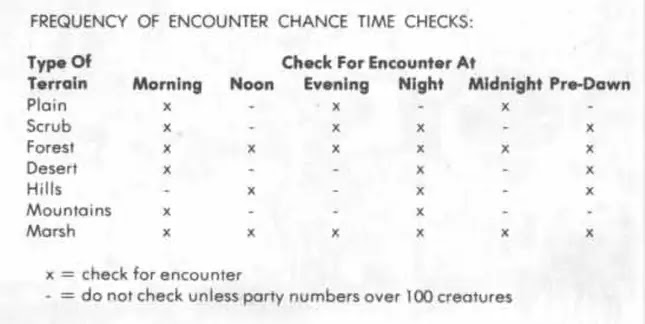
These decisions prompted a good bit of debate amongst the players, and this is why I really enjoy the complications introduced by using NPC party members, morale, random encounter checks, and varying terrain types (each with their own chance of random encounters).
Decisions like these are what make wilderness exploration fun and interesting. If the party hadn't included any NPCs, and if I didn't use morale rules, the players wouldn't have to account for their companions acting irrationally, unpredictably, or sub-optimally. They wouldn't have to decide whether or not to risk danger by looking for their lost companion. If I didn't use random encounter checks, none of this would have happened to begin with (unless I arbitrarily decided that it "should" happen, for one reason or another). If settled farmland and forests were treated as interchangeable terrain types, the decision to camp in the forest or push on to its edge would be meaningless.
In this case, I simply told the players out-of-character that there was a greater chance of having an encounter in the forest than in the settled hexes (2-in-10 versus 1-in-10), and that the encounters in the forest were generally more dangerous than in the settled region (in settled territory, there's a chance of encountering a patrol from the nearby town, which is more likely than not to be friendly - not so in the forest). In situations like these, I like to make the mechanics player-facing so that they can make an informed decision.
Ultimately, the players decided to wait and see if Terris would return - but not for too long. They would wait an hour and no more. That was plenty of time for him to wander back. If he didn't, well, they decided he wasn't worth going after. After an hour, they'd press on through the forest until they reached its edge, then they'd make camp.
Terris did not return - I used 2e's rules for getting lost and made a roll for Terris, and it turned out that he was hopelessly lost out there and couldn't find his way back. Poor guy. After waiting the agreed-upon amount of time, the party collected themselves and moved on. They escaped the forest without further incident.
After an uneventful night camping within eyesight of the little farms and hamlets surrounding Spiritbrook, the party traveled the remaining five hours to town - again, without incident - and made their triumphant return.
Town Business
Bernhardt was curious as to whether any priests in town might be able to resurrect the stonemasons who had died on the journey. Keeping in mind my conception of "tiers of play" in 2e, I had decided that the highest-level NPCs in town would be medium-level (levels 4-7), so I told Bernhardt's player that this was not possible. Higher-level priests and other NPCs could be found in the big fantasy city at the south of the regional map, creatively named Southreach.
The party returned to the stonemason's guild and received their reward in gold. The guildmaster expressed his gratitude, and promised that any business the party had with the guild in the future could be done at a discount. My hope is that the players will take the bait and inquire with the guild should they eventually decide to build strongholds, temples, and thieves' dens in the future.
Bernhardt and Karven Stone, being 3rd-level, were now able to have 1st-level henchmen. The party offered to keep Yinvalur onboard, so he became a henchman of Bernhardt's. Karven looked around town for henchmen and recruited a human thief named Sheyla.
It was at this point that the player of Rozidien Stoneskull, the paladin, decided to remove their character from the game and replace them with Ash, an elf fighter. I wrote in an earlier play report about my approach to switching characters. We hand-waved the tradeoff, quickly arriving at an explanation for one character's departure and the other's arrival. It doesn't really matter to me. We're here to play the game - the players should play the characters they want to play, and my goal is to facilitate that and move on as quickly and easily as possible.
After this, the players wanted to cash in their salvaged equipment and plundered gems for gold. They divvied up their respective shares and converted their assorted coins into more portable platinum coins. Then, they of course wanted to shop.

Adventurers Be Shopping
Whenever my players bring up shopping, I tell them "We're not going to do that now, but think about what you want to buy between sessions, use the PHB for prices, and message me if there's anything you're not sure of." I'm not going to spend game time shopping. I usually offer a one-session grace period after the party has been in town for players to retroactively say "I would have bought that in town" or whatever. Anything to keep the game moving.
The players were curious about buying magic items, and I'm admittedly still on the fence about this. The 2e DMG specifically cautions against (or perhaps more accurately, attempts to forbid entirely) the possibility of player characters purchasing magic items. Unlike 5e, for example, there is not even an attempt made to suggest prices or price ranges for magic items. The DMG points out that player characters probably aren't selling their magic items, so why would anyone else be doing so?
I certainly like the idea that magic items are incredible and that no one in their right mind would ever sell them, but realistically, in my experience, players do sell magic items, all the time. They probably would have sold the evil sword I gave them, if they hadn't handed it over to the NPCs last session. And, I am somewhat sympathetic to the common refrain among D&D players that "We have so much gold, but there isn't anything to spend it on!"
I personally think there are plenty of things to spend gold on, besides magic items - armies, expensive clothes, followers, influence, strongholds, and the like. But, this is a game, and for better or worse, most players like to spend their character's hard-earned gold on things that make their numbers go up or make their characters more fun or interesting to play, and I'm generally okay with that.
So, the question is, how much should magic items cost in 2e? To get a general idea, I referenced the XP values associated with magic items in the back of the DMG (starting on page 183). These values are how much XP a character gets for creating a magic item. Generally, in old-school D&D, 1 XP = 1 Gold. However, in the 2e DMG, in Chapter 8: Experience, it's recommended that rogues (and rogues only) get 2 XP for each gold piece of treasure (page 70), suggesting that in 2e, one could say that 2 XP = 1 Gold (or maybe that's just for rogues).
So, what if we take the XP values for magic items in the DMG and divide them by 2 to get their market value? In that case, a potion of healing costs 100 gold, which sounds right. However, a ring of three wishes costs 1,500 gold, which is absurd.
Luckily, I recently learned about an exhaustive four-volume collection from TSR called Encyclopedia Magica, which seems to catalogue every single magic item from all of the splat books, supplements, and the like, and assigns them gold piece values. In Encyclopedia Magica, a potion of healing is worth 400 gold (which is a bit high) and a ring of three wishes is 20,000 gold (which still sounds low). Well, it's what we've got.
I'll likely use my own judgment to finesse these values a little bit, and in any case, I'm certainly not going to let my players buy items that grant wishes, so that's something of a moot point. I don't want to mess with things too much until I get a good idea of how much treasure the player characters are actually going to accumulate over time - as with many things, 2e gives little to no guidance as to how much treasure to award, so I'm using guidelines from 1e to fill in the gaps (for example, a typical treasure hoard of gold in 1e contains 250 gold per level of the dungeon).
I decided that the players could buy potions and the like in towns and villages, but for anything else, they'd have to return to the big city. Despite finding a bunch of treasure on their most recent adventure, the players were too cheap to buy healing potions for 400 gold a pop. They simultaneously complained about having a bunch of gold and nothing to buy, and also about how things were too expensive.
A DM just can't win.

You Can Go Your Own Way: Rumors in the Sandbox
The next item on the agenda was to determine what the player characters would do next.
The player characters currently knew of two other quests from our first session - one quest involved an evil wizard in another town who wanted adventurers to kill some pegasi and steal their babies and eggs, which three-quarters of the party had already decided was far too sinister for them, and the other quest was to go to a nearby ruin and put an angry spirit to rest on behalf of a local priest, which sounded more palatable.
At this point, I gave the players the option of spending a week of downtime in town to recuperate and gather rumors about other quests, which they opted to do. Each of them received a rumor about a new quest. Ash and Haymond Baler, being 2nd-level, received two 2nd-level quest hooks:
- Grimerun and Shimmerhollow, a pair of villages to the north and east, need adventurers to root out a forest beast which has been preying on foresters from both villages.
- Pondwick, a town to the north, needs adventurers to clear out a nest of giant spiders which have settled on the outskirts of the surrounding farmland, eating livestock and the occasional farmer.
- Grasshold, a town to the north, needs adventurers to deal with a band of ogres which has settled on the outskirts of the surrounding farmlands and has been carrying off farmers to their lair.
- Houndrun, a town to the south, needs adventurers to deal with a tribe of barbarians who have been raiding and torching the town's logging camps.
 |
| A section of the regional map showing Spiritbrook in the far south and Pondwick in the far north. Just above Spiritbrook is Grasshold (with the Ogre Den revealed, since it's close enough to be spotted by locals). Grimerun and Shimmerhollow are roughly in the middle. |
 |
| Another section of the regional map showing Spiritbrook in the far north and Houndrun in the far south. In between is the Whispering Tomb and Southreach, the big city. |